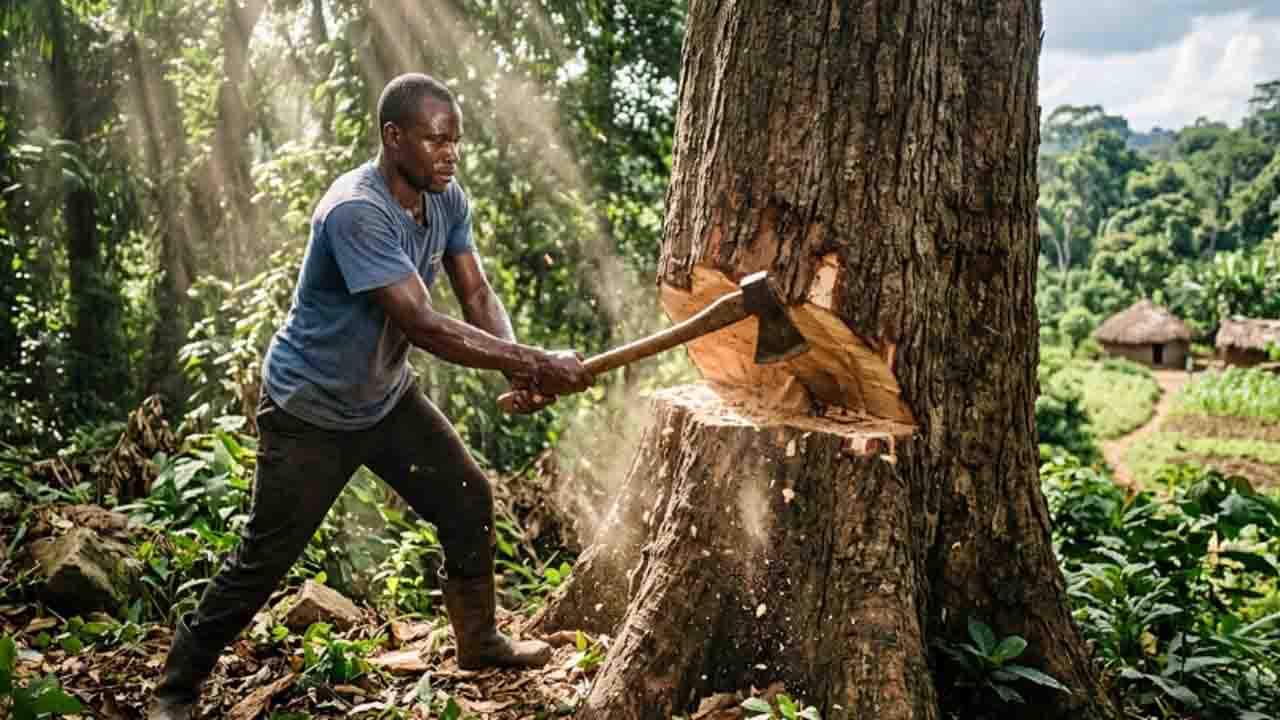

Africa has no shortage of trees, forests or land suitable for forestry. What is often missing is the long-term industrial thinking required to turn those natural resources into sustainable economic value.
A recent observation about Canada’s timber industry raises an important question for Africa:
Can African countries build profitable timber industries without destroying the forests they depend on?
The answer is yes — but it requires changing the way we think about trees.
Trees should not be viewed only as something to protect, nor should they be treated simply as something to cut down and sell.
They can also be grown as a renewable commercial crop.
The Canadian Lesson
Canada has one of the world’s major forest-product industries. Timber supports manufacturing, construction, exports, employment and communities across the country.
But the important lesson isn’t that Canada has somehow avoided severe weather because of its forests. Canada’s climate is influenced by geography, latitude, ocean currents and atmospheric conditions, among other factors.
The more useful lesson is forest management.
A timber economy can operate on the principle of:
Plant → grow → harvest → regenerate → grow again.
When properly managed, forestry can become a long-term cycle rather than a one-time extraction of natural resources.
That distinction is extremely important for Africa.
Africa Should Stop Thinking Only About Cutting Trees
In many parts of Africa, timber comes from natural forests.
When valuable trees are removed without sufficient regeneration, the country loses more than the individual trees.
It can lose biodiversity, soil protection, water regulation, carbon storage and future economic opportunities.
The alternative is to develop commercial plantations specifically for timber production.
Instead of depending entirely on natural forests, countries can establish managed plantations where appropriate species are planted, maintained and harvested according to long-term plans.
This creates a fundamental separation:
Natural forests can be protected for their ecological value, while commercial plantations can supply an industrial timber economy.
Trees Can Be an Agricultural Crop
One of the most important mindset changes is to recognize that plantation forestry can function much like agriculture — although trees have much longer growing cycles.
Farmers plant crops knowing they will eventually harvest them.
A commercial forestry company can do the same with trees.
A plantation might be established, managed for many years, harvested, and then replanted.
The objective isn’t to have the same tree standing forever.
The objective is to maintain the forest resource over generations.
That requires planning beyond the next financial year.
Africa Has an Opportunity to Build a Timber Industry
Many African countries import significant quantities of wood products even while possessing land and climatic conditions suitable for growing timber.
That represents an enormous opportunity.
Rather than exporting raw logs, Africa can develop industries around the entire value chain.
Imagine a tree becoming:
Seedling → plantation → timber → furniture → flooring → doors → construction materials → engineered wood products → finished products for export.
The economic value increases at every stage.
Instead of simply selling a log, African businesses can manufacture products that create jobs, develop skills and generate greater economic value.
Don’t Just Plant Trees — Build an Industry
Reforestation campaigns often focus on the number of trees planted.
But planting millions of trees is not enough.
Someone has to maintain them.
Someone has to manage the plantations.
Someone has to protect them from fire and pests.
Someone has to harvest them responsibly.
Someone has to process the timber.
Someone has to manufacture products.
Someone has to transport and sell those products.
That means Africa needs to think beyond tree planting and toward forestry ecosystems.
The goal should be to create businesses around the entire lifecycle of the tree.
Choose the Right Trees for the Right Places
There is also an important caution.
Commercial forestry should not simply mean planting one species everywhere.
Pine, eucalyptus and other commercial species can be valuable in appropriate environments, but the right species depends on climate, soil, water availability, biodiversity and the intended use of the timber.
Africa therefore needs forestry research that answers questions such as:
- Which species grow best in each region?
- Which species produce the most valuable timber?
- How long should each rotation be?
- How much water does a plantation require?
- What are the risks of pests and disease?
- Which areas are unsuitable for plantations?
- How can biodiversity be maintained?
- How can local communities benefit?
Good forestry is science, business and environmental management working together.
Governments Have a Major Role
Africa’s forestry transformation cannot depend entirely on individual farmers.
Governments can help create the conditions for long-term investment.
That could include:
- Clear land-use policies
- Secure land tenure
- Forestry research
- Seedling and nursery programmes
- Incentives for commercial plantations
- Strong environmental regulations
- Better roads and transport infrastructure
- Local timber-processing industries
- Training for forestry workers
- Transparent monitoring of timber production
- Measures against illegal logging
Forestry is a long-term investment.
A company planting trees today may not harvest them for many years.
Investors therefore need confidence that the land, regulations and business environment will still be viable when the trees mature.
Communities Must Benefit
There is another lesson Africa should take seriously.
Forestry projects should not simply acquire land, plant trees and leave surrounding communities with nothing.
Local communities should have opportunities to participate through employment, out-grower schemes, smallholder plantations, processing businesses and other forms of economic participation.
When communities benefit from sustainable forestry, protecting the resource can become part of their economic interest.
The question should therefore not only be:
“How many trees are we planting?”
It should also be:
“How many livelihoods are we creating around those trees?”
Don’t Confuse Reforestation With Replacing Natural Forests
There is one critical distinction that must not be lost.
A commercial plantation is not automatically equivalent to a natural forest.
Planting thousands of identical trees cannot fully replace the biodiversity and ecological functions of an intact natural forest.
That means Africa should pursue two complementary strategies:
Protect important natural forests.
And:
Develop sustainable commercial plantations on appropriate land.
Both can exist.
In fact, they should.
From Raw Materials to African Manufacturing
Perhaps the biggest opportunity is not simply growing trees.
It is what Africa can manufacture from them.
Consider the construction sector.
Instead of exporting logs and importing expensive finished wood products, African countries could develop domestic industries producing:
- Structural timber
- Furniture
- Doors
- Flooring
- Panels
- Plywood
- Packaging
- Prefabricated buildings
- Engineered wood products
This creates an industrial chain that employs foresters, engineers, factory workers, designers, truck drivers, technicians, salespeople and entrepreneurs.
One tree can support an entire economic ecosystem.
The Long-Term Mindset
Forestry also teaches an important lesson about economic development:
Some investments require patience.
A politician may think in terms of an election cycle.
A business owner may think in terms of annual revenue.
But a forestry investor may have to think in terms of decades.
Africa needs more businesses capable of thinking that way.
Plant something today that someone else may harvest tomorrow.
Build an industry that can outlive its founder.
Create forests that future generations can continue to manage and benefit from.
That is the kind of thinking that turns natural resources into lasting wealth.
Africa Doesn’t Need to Choose Between Trees and Economic Development
The debate is sometimes presented as though Africa has only two choices:
Protect the environment and sacrifice economic development.
Or:
Cut down forests and pursue economic growth.
That is too simplistic.
A better model is:
Protect natural ecosystems + establish appropriate commercial plantations + process timber locally + regenerate what is harvested + create economic opportunities for communities.
That is where sustainable forestry becomes more than an environmental policy.
It becomes an economic development strategy.
The Future Could Be Green and Industrial
Africa’s forests should not be viewed simply as obstacles to development.
Nor should they be treated as an unlimited supply of free raw materials.
They can be managed as long-term assets.
The real opportunity is to move from an extractive mindset to a regenerative one:
Don’t simply cut trees. Grow trees. Don’t simply export logs. Build industries. Don’t simply plant trees. Build an economic system around them.
Canada’s experience offers one useful lesson: forestry can become a major industry when resources are managed with long-term planning.
Africa can take that lesson and develop its own model — one that protects natural forests, grows commercial timber responsibly, creates jobs and turns renewable resources into locally manufactured products.
The tree we plant today shouldn’t only be measured by how much shade it provides. We should also ask what industry, jobs and opportunities it can create for the generation that eventually harvests it.