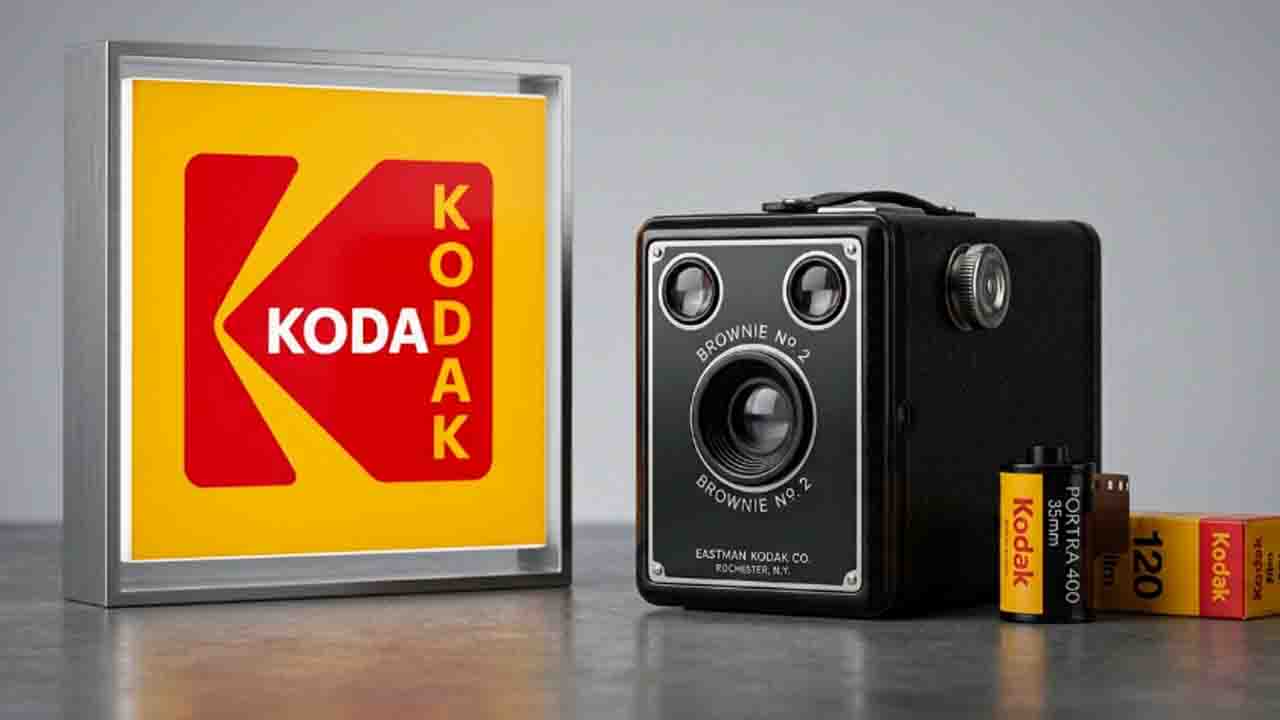

For decades, Kodak was one of the most recognizable names in photography. Its yellow-and-red branding was familiar around the world, its film was used by millions of people, and photography was closely associated with the Kodak name.
Yet Kodak became one of the most famous examples of what can happen when a successful company struggles to adapt its business model to a changing technology.
The irony is that Kodak actually invented one of the technologies that would transform photography: the digital camera.
The lesson for businesses is not simply “innovate or die.” It is more specific:
Sometimes the greatest threat to an established business is a technology that initially looks like it will destroy the business you already have.
Kodak Invented the Digital Camera
In 1975, Kodak engineer Steven Sasson developed an early digital camera prototype.
It was very different from the cameras people use today. The prototype was bulky, captured images at a very low resolution and took time to record an image.
But the fundamental idea was revolutionary: photographs could be captured electronically rather than on photographic film.
At the time, Kodak’s enormous business was built around film, photographic paper, processing and printing.
Digital photography therefore presented an uncomfortable question.
If people no longer needed film, what would happen to the business built around selling film?
That question is at the heart of the Kodak story.
The Problem Wasn’t That Kodak Had No Innovation
It is easy to tell the Kodak story as if the company simply refused to innovate.
That is too simplistic.
Kodak invested in digital technology and developed digital products. The company understood that photography was changing.
The deeper challenge was that the economics of digital photography were very different from the economics of film photography.
With film, taking photographs generated repeated purchases.
You bought film.
You took photographs.
You processed the film.
You printed photographs.
Then you bought more film.
Digital photography changed that cycle dramatically.
Once consumers had a digital camera, they could take hundreds or thousands of photographs without buying another roll of film.
Later, smartphones made photography even more accessible.
The technology didn’t simply create a new product.
It changed the entire business model.
When Your Biggest Customer Behaviour Changes
This is one of the most important lessons for businesses.
Companies often focus on their competitors.
But sometimes the bigger threat is changing customer behaviour.
Kodak’s customers didn’t wake up one morning and decide they no longer liked Kodak.
They simply began adopting a different way of taking, storing, sharing and viewing photographs.
The customer problem remained the same:
“I want to capture and preserve memories.”
But the solution changed.
That distinction matters.
Businesses should constantly ask:
What problem are our customers actually paying us to solve?
If the answer is clear, the company can adapt the way it solves that problem.
If the company becomes attached to a particular product, technology or revenue stream, it can mistake the current solution for the actual customer need.
Your Product Is Not Your Business
This may be the biggest lesson from Kodak.
Kodak was associated with film.
But film was not the ultimate purpose of photography.
People wanted to capture memories.
Film was simply the technology that made that possible for generations.
This distinction applies to almost every industry.
A newspaper is not really paper.
A bank is not really a branch.
A taxi company is not really a fleet of cars.
A university is not simply a physical campus.
A retail store is not necessarily a building.
These are methods of delivering value.
When technology changes the method, businesses that understand the underlying customer need can adapt.
Businesses that confuse their current product with their purpose may struggle.
Disruption Often Looks Small at First
Another lesson is that disruptive technologies don’t always look dangerous in their early stages.
The first digital camera wasn’t going to replace every film camera overnight.
Early smartphones weren’t as powerful as today’s smartphones.
Streaming initially had limitations.
Online shopping once seemed inconvenient compared with walking into a store.
Artificial intelligence is now changing many industries, but many businesses are still trying to determine exactly what that means for them.
The mistake can be waiting until the new technology becomes obviously superior.
By then, the market may already have moved.
Businesses should therefore ask:
“What technology today looks too small to threaten us but could become significant in five or ten years?”
That is a much better strategic question than simply asking what your competitors are doing today.
Don’t Protect Today’s Revenue at the Expense of Tomorrow
This is where disruption becomes particularly difficult for established businesses.
A company has employees, shareholders, factories, suppliers, customers and existing revenue streams.
A new technology may threaten all of them.
Management therefore has a natural incentive to protect the existing business.
But there is a danger.
The more successful your existing business becomes, the harder it can be to deliberately develop something that could eventually replace it.
That is why businesses should create room for new ideas before they are forced to do so.
A new technology may initially produce less revenue than the existing product.
That does not necessarily mean it is a bad investment.
It may mean the market is still developing.
Don’t Just Ask: “Will This Cannibalise Our Business?”
A company considering a disruptive product may worry:
“If we launch this, won’t it reduce sales of our existing product?”
Sometimes the answer is yes.
But there is another question that needs to be asked:
“If we don’t launch it, will somebody else eventually replace our existing product?”
This is a crucial strategic distinction.
Cannibalising part of your existing business yourself may be preferable to allowing another company to do it for you.
A successful company sometimes has to be willing to make its current product less important in order to remain relevant in the future.
Build a Culture That Can Challenge the Business
Innovation is not just about hiring engineers.
It is also about creating an organisation where people can challenge existing assumptions.
Employees should be able to say:
- Our customers are changing.
- This technology could change our industry.
- Our current revenue model may not last forever.
- We should experiment with something new.
- Our biggest competitor might not exist yet.
The most dangerous sentence in business can be:
“But this is how we’ve always done it.”
Past success is evidence that something worked in the past.
It is not proof that it will work forever.
What Businesses Should Learn From Kodak
The Kodak story offers several practical lessons.
1. Understand the customer, not just the product
Know what customers ultimately want and be prepared to change how you deliver it.
2. Watch emerging technology early
Don’t wait until a new technology becomes mainstream before taking it seriously.
3. Experiment before you are desperate
Small experiments are easier when the company is healthy than when its existing business is already collapsing.
4. Be willing to disrupt yourself
If a new product could eventually replace your existing product, consider developing it yourself.
5. Separate your purpose from your current business model
Your current revenue stream is not necessarily your permanent business model.
6. Don’t let today’s success create tomorrow’s blind spot
The stronger a company becomes, the easier it can be to become comfortable with the status quo.
The Bigger Lesson
The Kodak story is often reduced to a simple statement:
“Kodak invented the digital camera and then failed because it didn’t embrace digital.”
The real business lesson is more complicated—and more useful.
The challenge facing established companies is not simply recognizing new technology.
It is deciding how aggressively to respond when that technology threatens the economics of the business that made them successful.
Every generation produces technologies that challenge established industries.
Some companies adapt.
Others defend the old model for too long.
For today’s businesses, the question is therefore not:
“How successful are we today?”
It is:
“If our customers changed the way they solved their problem tomorrow, would our business still have a reason to exist?”
That is the question every business leader should be asking before the market asks it for them.